
In food and beverage production, pharmaceutical compounding, and industrial chemical manufacturing, a fraction of a degree on the Brix scale separates a compliant batch from a costly product recall. Whether you are measuring sugar concentration in beverages, checking salinity in food processing, or verifying the dilution of metalworking coolants, optical accuracy is non-negotiable.
For quality control (QC) managers, food technologists, and lab technicians sourcing a refractometer in Singapore, selecting the right instrument comes down to matching your sample’s concentration range and temperature sensitivity with the right optical technology.
At Lee Hung Scientific, we supply a complete lineup of professional refractometers—ranging from field-ready handheld optical units and water-resistant pocket digital meters to ultra-high-precision benchtop analyzers designed for strict QA/QC laboratories.
Not sure which Brix range fits your sample? Email our technical team at sales@leehung.com or call +65 6560 6900 for a rapid consultation.
The Hidden Cost of Inaccurate Brix and Refractive Index Readings
Relying on outdated, uncalibrated, or mismatched refractometers introduces immediate quality bottlenecks into your production line. In Singapore’s warm, high-humidity environment, ambient temperature fluctuations alone can skew liquid density and refractive index readings if your instrument lacks proper compensation.
When your team uses the wrong testing equipment, three major operational problems follow:
- Subjective Operator Error: Traditional analog refractometers require technicians to squint through an eyepiece and interpret a shadow line (borderline). Two technicians reading the exact same sample often record different values—especially with dark, milky, or viscous liquids like sauces, jams, or industrial oils.
- Temperature Drift: Refractive index changes rapidly with temperature. Without built-in Automatic Temperature Compensation (ATC) or internal Peltier temperature control, measuring a hot sample off the production floor or a chilled sample in a cold room produces false Brix percentages.
- Narrow Measurement Bottlenecks: Buying a low-range meter (0–32% Brix) for mid-to-high concentration samples forces technicians to manually dilute samples before testing—wasting time and introducing dilution math errors.
To maintain strict batch-to-batch consistency and pass HACCP, GMP, or ISO quality audits, your instrumentation must deliver fast, repeatable readings without human guesswork.
Why Leading QC Labs Source Their Refractometer in Singapore from Lee Hung Scientific
Different testing environments demand different optical specifications. Lee Hung Scientific provides proven laboratory and industrial refractometers tailored to your exact measurement scale, accuracy threshold, and workflow.
- Purpose-Built Models for Every Brix Range
Instead of forcing a one-size-fits-all meter onto your workflow, we stock specialized instruments engineered for distinct concentration levels:
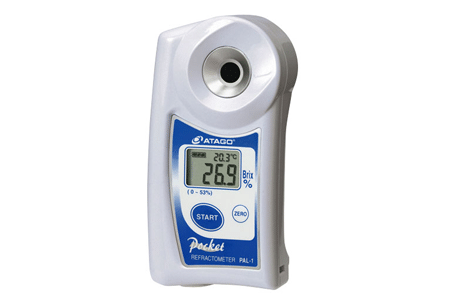
- Digital Pocket Refractometer PAL-1 (Brix 0.0 to 53.0%): The industry workhorse for fruit juices, coffee, soft drinks, soups, and water-soluble cutting oils. Delivers rapid digital readings in seconds with just two drops of sample.
- Digital Pocket Refractometer PAL-α / PAL-Alpha (Brix 0.0 to 85.0%): Built with a wide measurement range at an economical price point, making it ideal for labs testing both low-concentration liquids and thicker syrups or condiments.
- Digital Pocket Refractometer PAL-3 (Brix 0.0 to 93.0%): A full-range pocket meter capable of measuring almost any sample—from light liquid solutions to high-sugar concentrates, honey, and marmalade—with a high accuracy of ±0.1% Brix.
- Hand Held Refractometer: A durable, battery-free optical solution for quick field spot-checks where rapid visual estimation is preferred.
- Research-Grade Benchtop Precision (RX-5000α)
For QA/QC laboratories in the pharmaceutical, petrochemical, cosmetics, and flavor industries, pocket meters aren’t enough. We supply the Automatic Digital Refractometer RX-5000α (Brix 0.000 to 100.00%). Equipped with an internal Peltier thermo-module, it automatically heats or cools your sample to your target temperature without needing an external water bath—achieving an exceptional accuracy of ±0.03% Brix and ±0.00004 refractive index ().
- Hygienic, Chemical-Resistant Construction
From SUS316 stainless steel sample stages and scratch-resistant sapphire prisms on benchtop units to water-resistant (IP65) ABS housings on pocket PAL models, our instruments are built to withstand acidic fruit extracts, salty brines, and harsh industrial solvents while cleaning up in seconds with distilled water.
- Local Technical Support & Calibration Guidance
Operating out of Bukit Batok with full bizSAFE certification—alongside our regional branch in Selangor, Malaysia—Lee Hung Scientific Pte Ltd backs every instrument we sell. We help you match the right refractometer to your sample viscosity, opacity, and compliance standards.
Model | Type | Measurement Range (Brix) | Best Suited For |
Hand Held Refractometer | Optical / Analog | Application-Specific | Field spot-checks, quick visual dilution checks |
PAL-1 | Digital Pocket | 0.0 to 53.0% | Juices, beverages, sauces, industrial coolants |
PAL-α (PAL-Alpha) | Digital Pocket | 0.0 to 85.0% | Multi-purpose food & industrial liquid testing |
PAL-3 | Digital Pocket | 0.0 to 93.0% | Full-range food QC, jams, honey, concentrates |
RX-5000α | Automatic Benchtop | 0.000 to 100.00% | High-precision QA/QC labs, oils, pharma, R&D |
Ready to eliminate guesswork from your liquid concentration testing?
Compare Our Refractometer Models & Request a Quote or contact our Singapore technical sales team at +65 6560 6900 (sales@leehung.com).
Frequently Asked Questions (FAQs)
A refractometer measures the refractive index of a liquid—how much light bends as it passes through a sample—to determine the concentration of dissolved solids. In food and beverage production, it measures Brix (sugar content) in juices, sauces, and syrups. In industrial and clinical settings, it measures salinity, coolant dilution ratios, pharmaceutical purity, and urine specific gravity.
An optical handheld refractometer uses ambient light and requires the user to look through an eyepiece to manually read where a shadow line crosses a scale. A digital refractometer (such as the PAL-1 or RX-5000α) uses an internal LED light source and optical sensor to calculate the refractive index automatically, displaying an exact digital number with Automatic Temperature Compensation (ATC) to eliminate human reading errors.
Choose the PAL-1 (0.0–53.0% Brix) if you primarily test beverages, soups, sauces, or cutting oils. Choose the PAL-3 (0.0–93.0% Brix) if you need a portable meter that also handles high-sugar samples like honey, jam, or liquid concentrates. Choose the RX-5000α benchtop refractometer (0.000–100.00% Brix) if your laboratory requires 3-decimal-place Brix accuracy, refractive index () readings, and built-in Peltier temperature control.
To calibrate (zero-set) most digital refractometers, clean the prism thoroughly with a soft tissue, place a few drops of distilled or deionized water onto the sample stage, and press the “Zero” button. Once the display reads 0.0% (or 0.00%), wipe the water away and your instrument is ready to measure samples accurately.