

A refractometer helps laboratories and production teams check a sample’s refractive index or an instrument-specific concentration scale, such as Brix. The right choice depends on what you are measuring, the expected range, the accuracy required and whether you work at the production line, in the field or at a laboratory bench. This guide explains those differences and compares the instruments available from Lee Hung Scientific.
What does a refractometer measure
A refractometer measures refractive index: how much light changes direction as it passes through a sample. Depending on the instrument and its scale, that reading may be displayed as refractive index (nD), Brix or a concentration value calibrated for a particular application. Before ordering, confirm that the displayed scale matches the result your process needs.
Brix (°Bx) is based on sucrose dissolved in water. For a pure sucrose solution, 10° Brix corresponds to 10 g of sucrose per 100 g of solution under the defined reference conditions. In fruit juice, sauces or industrial mixtures, other dissolved substances can affect the reading. Brix can therefore be a useful process or quality-control indicator, but it should not automatically be treated as the exact sugar content of every complex sample.
Where are refractometers used
- Food and beverage: Checking the consistency of juices, syrups, sauces, jams and other products against a defined Brix range.
- Agriculture: Testing plant juices close to the source using an instrument suited to the expected range and sample type.
- Laboratories and industry: Measuring refractive index or concentration for formulation, quality control and process fluids using a suitable scale or method.
The same model will not suit every liquid. A low-Brix beverage, concentrated syrup and petroleum-related sample can require different measurement ranges or scales.
Hand-held, portable digital or automatic
An optical hand-held refractometer is portable and requires the user to read a scale through the eyepiece. Lee Hung’s hand-held range includes MASTER-RI for refractive index measurement of samples such as vegetable oils and petroleum products, MASTER-AGRI for Brix in plant juices, and MASTER-10 models for low-concentration Brix measurements up to 10%. Their different scales matter more than the fact that all three are portable.
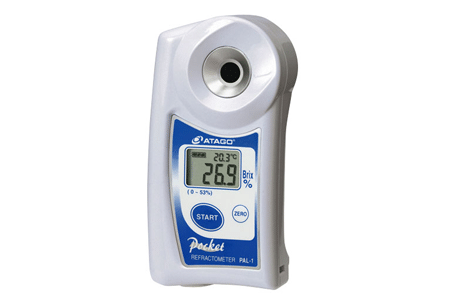
Portable digital PAL models display Brix directly, reducing the need to interpret an optical scale. They suit routine checks where only a few drops of sample are available. A benchtop automatic instrument such as the RX-5000α offers a broader range, finer resolution and controlled measurement temperature for demanding laboratory work.
Compare four refractometer models
These headline figures help narrow the options. Resolution tells you the smallest displayed increment; accuracy describes the stated closeness of a measurement to the reference. Check both rather than choosing by range alone.
| Model | Brix range | Accuracy | Typical fit |
| PAL-1 | 0.0–53.0% | ±0.2% Brix | Routine food and beverage checks |
| PAL-α | 0.0–85.0% | ±0.2% Brix | Wider range of concentrations |
| PAL-3 | 0.0–93.0% | ±0.1% Brix | Wide range with higher stated accuracy |
| RX-5000α | 0.000–100.00% | ±0.03% Brix | Controlled laboratory measurement |
The three PAL models provide 0.1% Brix resolution, use about 2–3 drops of sample, give a reading in approximately three seconds and carry an IP65 water-resistant rating. PAL-α and PAL-3 list automatic temperature compensation from 10°C to 100°C. Their main differences for a buyer are measurement range and, for PAL-3, its tighter stated Brix accuracy.
For laboratory work, the RX-5000α also measures refractive index from 1.32700 to 1.58000 nD, with stated nD accuracy of ±0.00004. It has 0.01% Brix resolution, 0.00001 nD refractive-index resolution and temperature control from 5.00°C to 60.00°C. Its built-in thermo-module removes the need for a separate constant-temperature water bath for instrument temperature control. Results can be sent to compatible printers or computers via its specified RS-232C interface.
View model details: PAL-1 | PAL-α | PAL-3 | RX-5000α
How to choose the right refractometer
- Start with the sample and scale. Do you need Brix, refractive index or a different concentration scale? Check that the instrument and its method suit the material being tested.
- Match the expected range. A unit that does not cover the sample cannot provide the result you need. Consider the lowest and highest values you expect in routine use.
- Set your accuracy requirement. Routine process checks and controlled laboratory testing may call for different levels of accuracy and resolution.
- Consider temperature and workflow. Temperature affects refractive index. Decide whether temperature compensation or active control is appropriate, where testing will take place and how many measurements operators will make.
For frequent production checks, a portable digital model may simplify reading. For controlled laboratory measurements or work requiring both Brix and refractive index, compare the automatic benchtop model against your procedure.
Refractometer support in Singapore
Established in 1983, Lee Hung Scientific supplies hand-held, portable digital and automatic refractometers. To narrow the choice, share your sample type, expected range, required accuracy, testing location and any method or documentation requirements. The team can discuss the available models and provide product information for your application.
Explore the range: Refractometers at Lee Hung Scientific