Let’s be honest. Nobody wakes up thrilled about checking HVAC pressure drops or counting microscopic dust particles. But if you’re running a cleanroom, managing a lab, or just trying to keep a commercial building’s air quality up to code, you know exactly what happens when things go wrong. It’s a massive headache.
Over the years, I’ve seen facility managers struggle simply because they weren’t using the right monitoring gear. They’re either bogged down by overly complicated tools or using cheap knock-offs that give wildly inaccurate readings.
So, let’s cut through the noise. If you want to actually get a grip on your facility’s environmental data, here is the equipment that realistically makes the daily grind so much easier.
Chasing the Invisible: Particle Counters
You can’t fix what you can’t see, right? When you need to nail down indoor air quality or certify a cleanroom, handheld airborne particle counters are basically your best friends.
If you are doing daily rounds, look into the H8300 and H8500 series (like the H8306 or H8503). These things are fantastic because they pick up particles as tiny as 0.3 microns up to 25 microns right off the bat. The built-in internal pumps run at a steady 0.1 CFM, which does the heavy lifting for you while you walk the floor.
On the flip side, if you are tired of carrying equipment around and need something to sit there and do its job, a remote benchtop unit like the B7301 is the way to go for continuous tracking. You need that immediate feedback to know your filtration systems aren’t failing behind your back.
Stop Guessing Your Airflow
I can’t count the number of times I’ve seen maintenance crews try to estimate ventilation performance by just “feeling the air.” Spoiler alert: it never works.
If you want to balance a system properly and keep energy costs down, you need solid data. The VelociCalc lineup is pretty much the industry gold standard here.
- For the basics: If you just need to check velocity and temperature, grab the VelociCalc 9515. It does the job beautifully without overcomplicating things.
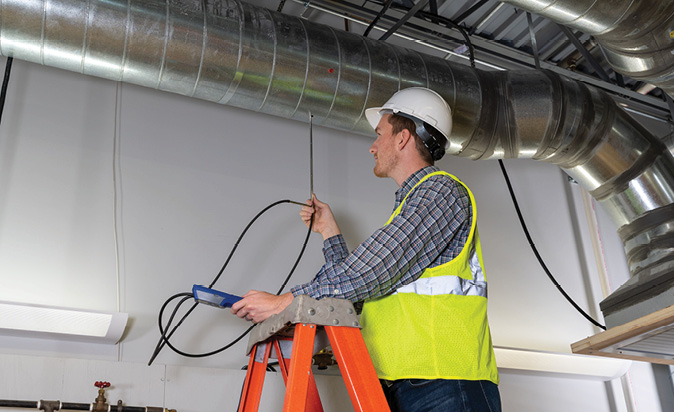
- For tricky ductwork: Stepping up to the 9535 (or the 9535-A with the articulated probe) makes life infinitely better because it actually calculates the flow for you. Trying to reach a weird ceiling vent? That articulated probe is a lifesaver.
- For the hardcore audits: If you are doing full-scale ventilation testing, you need the VelociCalc 9600 Series or the Multi-Function 9565. These units give you velocity, temp, humidity, and differential pressure all at once on a real-time display. It turns a three-hour audit into a forty-five-minute job.
Don’t forget about rotating vane anemometers either. Something like the VelociCalc 5725 is perfect when you need to measure across a larger surface area like a return grille.
Pressure Drops and Hidden Issues
Finally, let’s talk about static pressure. If your pressure is off, your whole system is essentially fighting itself.
Grabbing a solid micromanometer lets you figure out exactly what’s going on inside those ducts. The DP-Calc 5815 is great for straightforward differential and static pressure checks. But if you have to report this data to a client or management, spend the extra bit on the DP-Calc 5825. It comes with data logging, which saves you from scribbling numbers on a clipboard that you’ll inevitably lose. Plus, pair either of these with a Pitot tube, and suddenly you have spot-on velocity readings in really tight, high-heat spaces.
The Bottom Line
Look, the gear you choose heavily impacts your daily routine. Don’t cheap out on the stuff that keeps your environment safe, compliant, and breathable.
If you are based around Singapore or Malaysia and are looking to upgrade your facility’s toolkit, you can find all these heavy-hitters over at Lee Hung Scientific. They carry the reliable stuff so you don’t have to second-guess your measurements.
Stay safe out there, and keep that air clean!